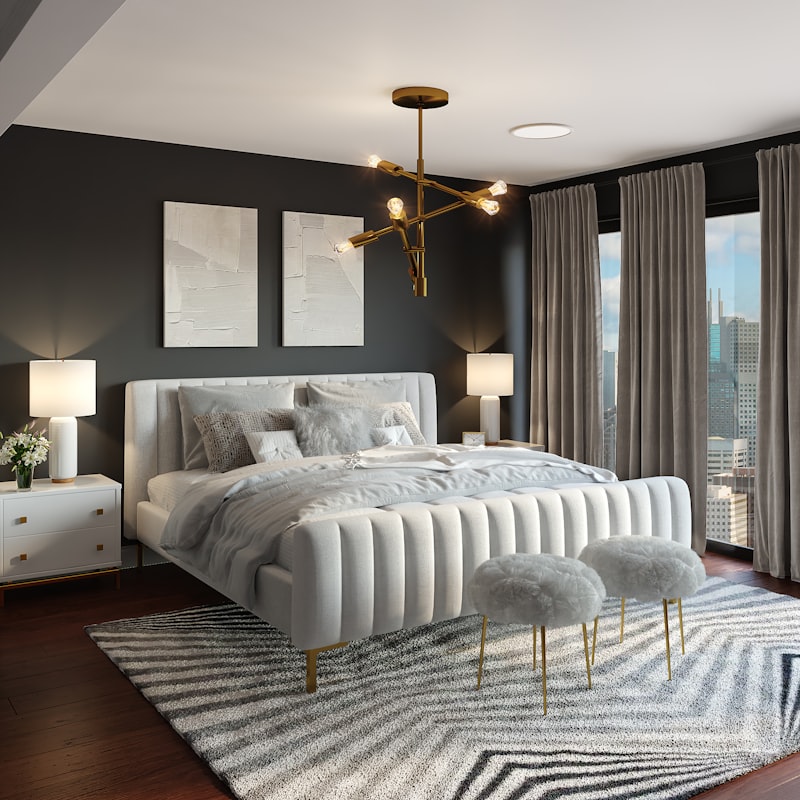
Inside a primary suite, the sculptural relationship among headboard wall architecture, thick layered mattress elevation, nightstand width, and shaded bedside sconces anchors the entire room long before art hangs on surrounding elevations. When buyers order tall beds indiscriminately alongside dainty 18-inch side tables, tiny dwarfed lamps, and uncoordinated electrical switches, spacious high-ceilinged primary bedrooms feel fragmented and residentially awkward.
Architectural suite proportioning calibrates vertical wall presence, ergonomic reach height at mattress top, and generous horizontal flanking symmetry cleanly. Whether commissioning full-wall wrapped suede panels integrated straight across wall-hung walnut drawers or freestanding tailored upholstered wings, respecting mathematical bedside ratios ensures daily reading comfort alongside effortless architectural calm. Discover our full collection of suite layouts inside our Bedroom Sanctuary hub.
1. Calibrating Mattress Elevation Against Nightstand Surface Height
Nothing strains shoulder muscles more subtly at night than fumbling blindly up or awkwardly down off tall custom beds toward mismatched side tables. With contemporary luxury mattresses stacked over spring foundations frequently rising to 27 to 31 inches total off finished wood floors, standard old 21-inch mid-century side tables fall six inches too short—vanishing virtually below duvet folds and exposing dangling alarm clock wires cleanly along raw walls.
Specify nightstand top heights sitting either flush level with finished mattress top planes or within plus-or-minus 1.5 inches (meaning crisp 26 to 29 inches tall for substantial pillow-top upholstered frames, or low streamlined 19 to 22 inches beside architectural Japanese-style platform beds). Keeping table depths between 18 and 21 inches keeps water carafes, reading spectacles, and hardcover novels smoothly within natural arm arcs cleanly without colliding sideways into flanking doorway trim.
| Bed Frame Size | Ideal Upholstered Headboard Height | Recommended Nightstand Width (Each) | Flanking Wall / Swing Lamp Span |
|---|---|---|---|
| Queen Frame (60" W × 80" L) | 50" – 58" overall height | 24" – 28" W × 18" D | Minimum 11'–6" wide primary headboard wall |
| Standard King (76" W × 80" L) | 54" – 66" (or full-width wrap) | 28" – 36" W × 19"–21" D | Minimum 13'–6" wide clear wall composition |
| California King (72" W × 84" L) | 54" – 66" tall sculpted panel | 28" – 34" W × 19"–21" D | Allow 36"+ clear walk aisle at foot bench |
| Extended Architectural Wall Wing | 96" – 108" full ceiling height | 32"–44" cantilevered floating drawers | Spans continuous 14'–18' feature wall monolith |
2. Headboard Wall Coverage: Standard Width vs. Extended Architectural Panels
In architectural suites boasting crisp 10-to-12-foot ceilings and fourteen-to-eighteen-foot bed wall spans, ordering a standard 78-inch upholstered headboard alone leaves three to four feet of empty sterile drywall stretching timidly behind small tables on either flank. Instead, architects extend horizontal upholstered padded wall panelling cleanly across the full composite width enclosing both nightstands—wrapping anywhere from 130 to 190 inches cleanly across horizontal wall rhythm.
Dividing wide extended headboard compositions softly via 6 mm recessed bronze inlays, vertical acoustic timber battens, or blind-stitched linen channel tufting stops towering padded elevations from mimicking heavy commercial hotel lobbies. Better yet, padding walls softly out past nightstand edges captures acoustic room slap echo effortlessly while giving hardwired brass bedside reading arms crisp anchored backing points instead of shaky bare hollow gypsum drywall.
Comparing Upholstered Silhouette Archetypes
- Deep Channel-Tufted Architectural Panel: Clean vertical 8-to-12-inch stitched seams draw tall 11-foot ceilings subtly upward while padding shoulder posture reliably without dust-trapping deep diamond buttons.
- Subtly Winged Envelope Frame: Curved 6-to-10-inch gently wrapping side wings frame sleeper peripheral vision warmly in huge cavernous lofts without sealing rooms claustrophobically off surrounding windows.
- Floating Low-Slung Plinth Platform with Detachable Bolsters: Low architectural timber bed rails floating effortlessly cleanly above crisp concealed toe-kicks pair effortlessly alongside thick cantilevered linen cushion bolsters hung via saddle leather loops cleanly off solid walnut rails.
3. Floating Cantilevered Nightstands vs. Skirted Timber Tables
Visual lightness across floors affects perceived bedroom scale intensely. Heavy boxy oak chests slamming flat down onto floors right next to solid upholstered skirted storage bed boxes fill corner floor lines heavily, pinching smaller urban apartments visually down within minutes. By lifting bedroom mass gently up on slender recessed brass plinths—or specifying floating wall-hung walnut drawers anchored solidly onto concealed steel cleat brackets directly into wall studs—unbroken plank oak and soft carpet stretch freely out right underneath bedside alcoves.
Notice clean clearance discipline with floating cabinets: hang cantilevered drawer undersides strictly at 9 to 12 inches clear above finished floor rugs, allowing robotic floor vacuums effortless room circulation while keeping drawer upper deck tops squarely balanced within one inch of mattress tops. Conversely, inside breezy sprawling estate master bedrooms craving warm visual solidity beside exposed tapered timber frame beds, grounded sculptural travertine or woven parchment two-drawer bedside chests add reassuring stone anchor stability cleanly across thick hand-knotted rugs.
4. Bedside Sconce Mounting Heights and Table Lamp Shade Ratios
Bad bedroom lighting shows immediately at night: towering skinny bedside table lamps cast harsh exposed bare LED glare directly underneath eyes whenever readers recline comfortably backward, while low tiny decorative ceramic bulbs vanish behind oversized Euro squares leaving printed novel pages squinting in dim shadow.
- Ideal Bedside Table Lamp Height Ratio: Select total table-lamp height (table surface up cleanly toward finial peak) measuring roughly 24 to 28 inches cleanly above nightstand tops, positioning opaque linen shade bottom lips right around 44 to 48 inches off finished bedroom floors—resting right alongside seated cheek/ear line so soft downward beam splashes cleanly onto book pages completely shielding glare horizontally across pillows.
- Shade Width Discipline: Choose generous tailored drum or softly flared empire linen shades measuring roughly 12 to 15 inches across base diameters—maintaining at least 3 inches open border rim between outermost shade overhang and nightstand front/side edges so lamps never overhang or tip over clumsily reaching for glasses.
- Hardwired Swing-Arm & Alabaster Wall Sconces: Free entire narrow 20-inch nightstand stone tabletops from bulky lamp bases cleanly by mounting articulated unlacquered bronze reading arms neatly on side bed margins at 52 to 56 inches above floor level, accompanied by subtle pin-beam 2700K directional reading snoots letting partners sleep peacefully completely undisturbed mere inches away. Browse detailed height charts inside our Alabaster & Cast Brass Sconces guide.
5. Choosing Tactile, Cleanable Fabrics Behind Head Zones
Even fastidious homeowners inadvertently press natural scalp hair oils, skincare lotions, and cotton pillow mist slowly over the exact center zone of soft padded headboards night after night. Ordering pristine uncoated delicate silk damask or fragile open rayon viscose flat across fixed non-removable padded walls guarantees stubborn dark oily ghost patches inside eighteen months.
Protect long-term tactile poise cleanly by selecting dense high-performance organic upholstery yarns engineered gracefully for daily touch: tightly woven heavy Belgian upholstery flax pre-finished safely via zero-PFAS botanical spot shield, structured oatmeal virgin wool boucle naturally resisting skin oil penetration cleanly via sheep lanolin, crisp top-grain matte aniline leather warming effortlessly with time, or fully removable Velcro-mounted buttoned slipcovered linen headboard jackets engineered smoothly for gentle dry cleaning between seasons. Review breathable textile layering cleanly in our Luxury Bedding Layering guide.
6. End-of-Bed Benches, Ottomans & Clearance Corridors
Placing an upholstered leather bench or carved solid oak spindle settee gracefully across the foot of a grand King bed completes visual balance cleanly across spacious rooms while furnishing functional morning dressing rest for tying shoes or parking folded velvet throws at night. Keep bench proportions tailored crisply: length should measure roughly 75% to 90% of mattress width (56 to 68 inches cleanly behind standard 76-inch King frames) without poking wide beyond side rails into walking paths, and seat height should drop strictly 2 to 4 inches *below* top mattress surface (around 17 to 19 inches high).
Never shoehorn benches blindly into snug apartment spaces if remaining passage clear corridor between bench front edge and facing fireplace walls drops below 32 inches—maintaining comfortable unobstructed walk corridors trumps decorative completeness every single time. Check spatial circulation guidelines inside our Biophilic Primary Bedroom guide.
7. Asymmetric Pairings: Mixing Nightstand Silhouettes Thoughtfully
Symmetrical twin walnut drawer chests frame formal centered bedroom compositions calmly, yet structural window cutouts or uneven closet doors occasionally force clever deliberate asymmetry instead. Mixing one generous 34-inch fluted linen closed three-drawer chest on the deeper room flank cleanly alongside a sleek open round travertine cylinder pedestal—matched smoothly in height alignment cleanly across opposite mattress planes via synchronized overhead asymmetric reading pendants or uniform bronze wall arms—maintains deliberate intentional architectural mastery without mirroring showroom rigidity awkwardly.
Learn how custom joinery details unite beds seamlessly beside fitted wardrobes inside our Fitted Wardrobes & Dressing Rooms guide or discover custom solid wood construction details via our Furniture Craftsmanship hub.
Frequently Asked Questions
How tall should a custom headboard sit if my primary suite has 11-foot ceilings?
Avoid skimpy 42-inch low headboards along soaring 11-foot elevations—they vanish awkwardly below generous wall voids. Select substantial freestanding vertical proportions spanning 58 to 68 inches high, or embrace clean full-width acoustic timber and upholstered wall wainscoting stretching horizontally across 14 to 16 feet rising boldly right up to 96 inches or full architectural ceiling reveal shadows.
Are marble or travertine nightstand tops practical for late-night water glasses?
Only when finished strictly matte honed and sealed thoroughly via breathable fluoropolymer stone protectants—alongside leather-lined stone trays ready for glass condensation rings. Alternatively, recess solid walnut veneer surfaces neatly inside crisp stone aprons to gain warm tactile contact without icy surface chill.
Should bedside electrical outlets sit above or below nightstand surface decks?
Avoid ugly visible duplex wall plates puncturing calm plastered walls neatly above table decks at 32 inches. Place hidden AC outlets cleanly at 16 to 19 inches high tucked behind closed table backs—bringing seamless braided lamp wire channels cleanly upward behind drawer reveals or integrating sleek in-drawer USB-C charging docks discreetly inside top drawer compartments.
How much space should remain unobstructed around the sides of a King bed for making linens cleanly?
Preserve cleanly at least 30 to 36 inches clear aisle beyond outer edges of nightstands and bed rails along both active flanks so fitted sheets wrap effortlessly round heavy mattress corners without grazing perimeter drywall radiators or closet pulls.
Explore custom lighting ergonomics in our Lighting Architecture hub, read about our editorial verification guidelines on About Luxury Decor Hub, or contact our editorial studio at Contact Us.